
Characters of the Blades of Alcrést

Ílorísían Empire
Makarí of Lorísé Níamé Ílorísía
Third Prince of the Ílorísían Empire
• Ílorísían Imperial Family • Lorísé Sénía •
A brilliant but reluctant prince whose talent for strategy and politics only becomes apparent after the imperial succession crisis tightens the grip of fate around his neck. Sarcastic, covetous and loyal, Makarí is less interested in the power struggles than the struggle is interested in him.

Principality of Nélissé
Sotíría of Kanalísa Satorí Nélissé
First Princess of the Principality of Nélissé
• Nélissé Royal Family • Kanalísa Kosonía •
A naïve and bubbly princess who has never known the true cost of the realities of the systems that her family represents until the fires of war and exile come for her, too. Curious, friendly and surprisingly insightful, she yearns for the simpler times when the world made sense.

Ílorísían empire
Kíríël of Lorísé Mísaral Ílorísía
First Princess of the Ílorísían Empire
Aegirine Order Ice Mage
• Ílorísían Imperial Family • Lorísé Sénía • Mísaral Kosonía •
A composed and formidable princess who understands the empire’s finances, secrets and people better than its rulers do. Recognizing where true power lies in the empire, she builds influence where no one thinks to look.

Ílorísían empire
Mayura of Níamé Makokída Ílorísía
Empress Consort of the Ílorísían Empire
• Ílorísían Imperial Family • Palénsía Royal Family •
A foreign born princess who rose from a concubine to Empress Consort through strategy, cold calculation and the birth of the heir. She is graceful, ambitious, loving and acutely aware that the survival of the dynasty she birthed depends on household politics as much as battlefield victories.

Ílorísían empire
Sélén of Lorísé Eaäsia Ílorísía
Second Prince of the Ílorísían Empire
Imperial Army Third Sword
• Ílorísían Imperial Family • Lorísé Sénía •
Raised as the empire’s spare heir, he has spent his life preparing for a throne that was never supposed to be his. Disciplined, confident, assertive and a fiercely capable swordsman, he is a soldier-prince whose sense of duty is complicated by resentment and love.

Principality of Nélissé
Aruno of Koönda
Knight Captain of the Nélissé Royal Family
The Shield of the Enduring Sky
• Kanalísa Royal Army • Order of the Enduring •
Born in a rural kosonía with noble blood and nobler roots, his life has been an exercise in choosing duty over all else. However capable he is at his job, his inability to separate his profession from his personal life is both foolish and idealistic to the detriment of those who care for him, those he claims to love.

Mercenaries
Atínasha of Tayaría
Mercenary Earth Mage
Thulite Order Earth Mage
Dark and mysterious, she wanders the continent in search of coin by way of odd jobs and caravan escorts. She is intelligent and well versed in survival on the road. Most mercenaries in the world are chasing their destiny, while others, like Atínasha, are actively running from it.

The witches
Fénríya of Éléunaìä
The 17th Second Witch of the Faithful Adorant
The Witch of Desire
The Witch of Calamity
Chief Imperial Mage of the Ílorísian Empire
Aegirine Order Mage
• Ílorísían Imperial Army • Sisterhood of Witches •
Beautiful, supremely powerful and a hopeless romantic, she is the embodiment of her titles. She lives in the shadow of the great Witches who came before her. She can be passive and dependent, but mistake this Witch for weak at your own peril.

Ílorísían Empire
Nomíkí of Akaríïrié
Assistant to the Chief Imperial Mage of the Ílorísían Empire
Imperial Army Fourth Mage
Thulite Order Projectile Mage
The Glass Mage
• Ílorísían Imperial Army • Líoríané Company • Naralíné College •
Loyal, capable and reserved, she has risen right alongside Fénríya, best friends since school. Despite having poor eyesight, she has a talent for projectile magicka and is resourceful enough to use looking stones to correct her myopia, the first true example of corrective optics as an accessory.

The Witches
Aétéría of Korína
The 17th First Witch of the Dawn’s Lament
The Witch of the Sword
The Witch of Lament
High Inquisitor of the Rínadaésé
• Rínadaésé Inquisitorial Office • Sisterhood of Witches •
Perhaps the most dangerous person on the continent, she is known to be ruthless, cold and completely entrenched in her own dogma. She has honed herself into a fighting machine with her Balailan steel sword engraved with runes, ‘Kuríkana’, the burning sword of the morning. How and why a Witch would become an inquisitor, of the same organization that hunted Witches in the past, remains an enigma.

THe Witches
Karísa of Ríanorí
The 15th Fourth Witch of the Unbroken Wilderness
The Witch of Impulse
The Witch of the Lost
• Sisterhood of Witches •
A bohemian, nonconformist free spirit, she wanders the continent in wonder of the natural world, documenting, sketching and making new discoveries. Despite her open demeanor, her inability to form long-lasting meaningful connections leaves her deeply lonely. The cost of freedom in this world often comes at great personal sacrifice.

Mercenaries
Éléutía, the Soothing Wind
Named Mage: The Soothing Wind
Aegirine Order Healing Mage
• Naralíné College •
A seasoned mercenary and battle-tested mage who earned her name during the Unification Wars, she now spends her time roaming the continent, making a life with her lover, Néyata. They are inseparable, having both abandoned their oaths and obligations, choosing love and companionship over duty.
Explore the Continent
Explore the kingdoms, dominions and territories that shape the fate of Alcrést.

Eastern Alcrést
Central Alcrést and the Émísén Nations
Western Alcrést
Subcontinent
Timeline of the Third Dawn
The events of the Blades of Alcrést occur in the Third Dawn (TD), the fourth recognized age of civilization on Téléra.
It began with the Pre-Dawn Age (PD), an age of prehistory that ended when the first peoples awakened.
The First Dawn (FD) was a mythic age, marked by the rule of the god-like Amísén, that lasted nearly 5000 years.
The Second Dawn (SD) was the age of early free civilization that formed the backbone of the cultures of today. This period saw the rise of kingdoms, and lasted nearly 900 years.
The Third Dawn is the age of the Witch, marked by impressive technological leaps in mathematics and science and shifts in society and culture. It is currently year 350 TD.
356 Ísharan Year, 350 years ago
The Third Dawn Begins
Scholars recognize this year as the start of the Third Dawn. It also coincides with the first year of the 10th Rínadaésén era.
The First, Second and Third Witches are granted internationally recognized titles. The First is granted a title in continuous valorous service to a monarch, the Second is granted a title as an international icon, and the Third is granted her title in recognition of her efforts in founding and instructing in the magicka college system.
402 Ísharan Year, 303 years ago
The Fall of Manarína
The Kingdom of Manarína falls into ruin, collapsing into an anarchy of loose states and warring factions. Queen Hakura of Manarína, the 10th Fifth Witch of the Encircled Star is killed at 29, becoming legendarily known as the Witch of Silence.
404 Ísharan Year, 301 years ago
The Kingdom of Ílorísía is Founded
In the chaos of its southern neighbor, the Kingdom of Nélissé provides assistance and backing to the Séna (duke) of Lorísé, the lord of the wealthiest Sénía (duchy) in the former war-torn Manarína. With the help of their benefactor to the north, the Séna assumes the throne, and renames the country the Kingdom of Ílorísía.
493 Ísharan Year, 212 years ago
The Naralíné College is Founded
The Naralíné College of Illumination is established in the city of Naralíné in the Sénía of Lorise, Ílorísía and the city gains the title Mayoka-cho Naralíné (the Magicka City Naralíné).
607 Ísharan Year, 98 years ago
The Unification Wars Begin: Casus belli
Ílorísía invades the neighboring Ísénía of Dínalí (Grand Duchy of Dínalí), igniting the conflict that later generations would remember as the Unification War. It begins as a dispute over noble insult and retaliation over honor, but soon becomes the first movement of a kingdom willing to redraw the western continent by force.
622 Ísharan Year, 83 YEars ago
Nélissé and Kotayan Enter the War
After Dínalí surrenders, Ílorísía invades Naíto over border disputes in 620 IY. The other nations watch cautiously.
Ílorísía invades Suruka in 622 IY with no apparent justification, and it seems prudent to declare war before they’re caught unprepared. Nélissé and Kotayan declare war on Ílorísía.
628 Ísharan Year, 77 years ago
The Ílorísían Empire is Formed
After the Kingdom of Naíto surrenders, it is annexed into Ílorísía. Now with dominion over Ílorísía, Naíto and Dínalí, The Ílorísían Empire is formed as the Imperial Dominions of Ílorísía, and the first Emperor is named.
651 Ísharan Year, 54 Years ago
Nélissé Negotiates a Ceasefire
After Suruka is conquered, Ílorísía brilliantly negotiates a non-aggression pact with Lumínasé, Nélissé’s major benefactor, who stops the flow of food, weapons and money into Nélissé.
Thanks to strategic intelligence and well placed bribes, they manage to locate and kidnap Sonoro, the Crown Prince of Nélissé, forcing the King to offer to negotiate a ceasefire and terms of surrender.
652 Ísharan Year, 53 years ago
Nélissé Capitulates
With no support and their future in enemy hands, Nélissé officially agrees to vassalage. The Nélissé King is made High Prince, and the Kingdom is renamed to the Principality of Nélissé.
In response to the new superpower in the west, the Émísén Pact is signed by the member states and Míresía and Ríanésía unite into one High Kingdom.
The Ílorísían Unification war is effectively over.
705 Ísharan Year, Present DAy
Fifty-Four Years of Vassalage
For fifty-four years, tensions have been brewing in the wounded Nélissé, under the shadow of the empire it helped create. But the old wounds have yet to heal, and vassalage is not peace.
Arcana of Alcrést
There are four known arcane arts practiced by the peoples of Alcrést, with varying levels of access and availability. Some require intensive study, while others are inherent to one race or another. They generally fall into one of two classifications that detail how the interact with the natural world: by transformation or by interference.

Arcane INTERFERENCE art
Magicka
The art of harnessing elemental forces and crystals.
Known as mayoka in Laénaran, or majíka in Atiriníl.
On first glance, magicka may seem to be a fantastic show of the elements, but a mage spends more time solving equations, reading harmonic frequency charts and studying fluid dynamics than shooting flames and freezing water.
Magicka is an art that combines science and talent with advanced knowledge of mathematics and calculus, as well as years of intensive study in natural sciences to use effectively.
At its essence, it is simply the ability to interfere with the natural passive process that crystals use to store energy, causing a phase-shift that instead releases the energy. The control of the release is called a spell.
arcane Transformational science
Alchemy
The science of materials transmutation and synthesis.
Known as rokénhagé in Laénaran.
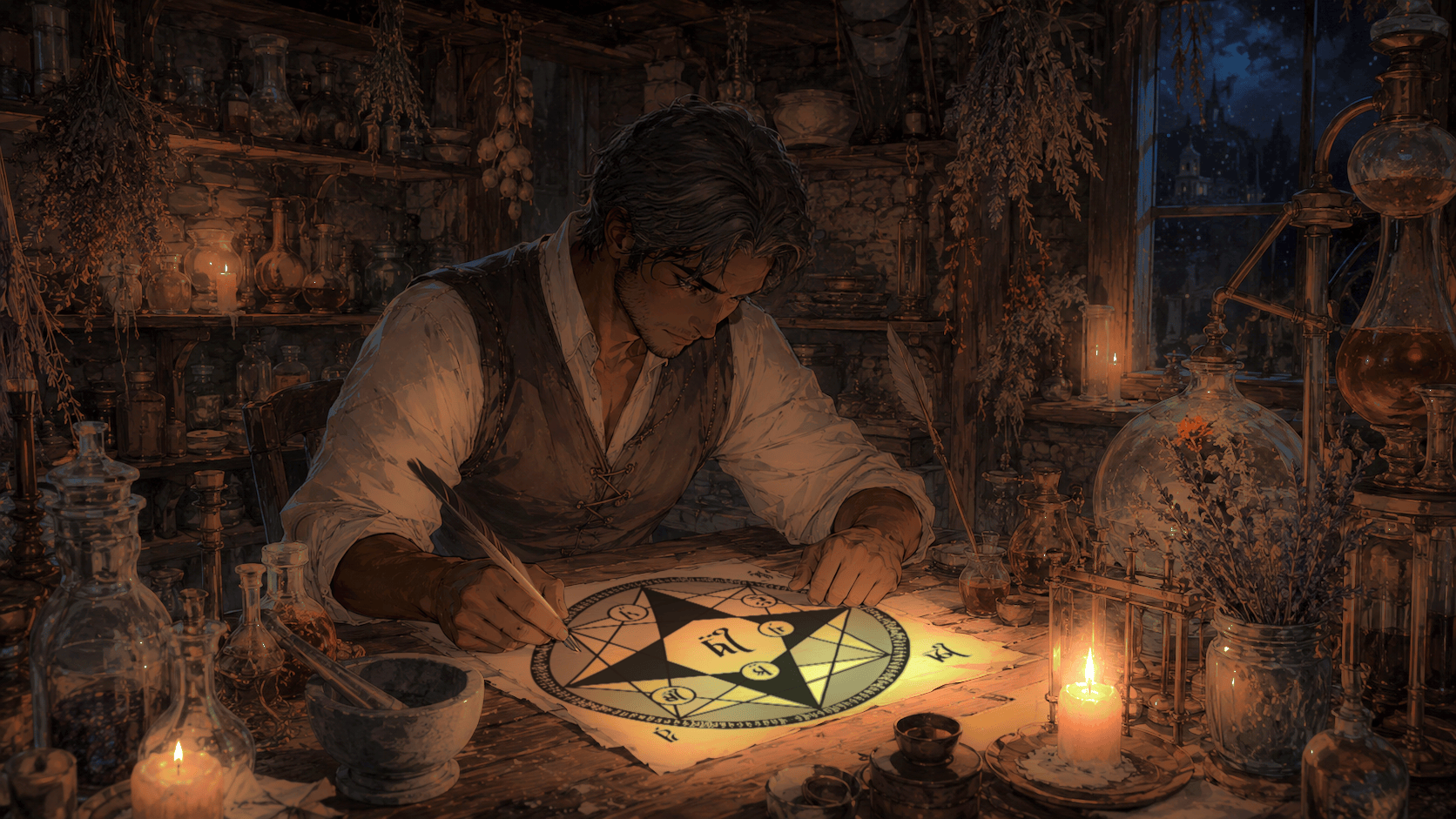
The advent of alchemy was the first industrial revolution on the continent, democratizing materials processing and production of goods. With the right alchemical arrays, an alchemist can smelt ores into ingots, and ingots into steel blanks, limited only by their ink and specialized paper called an array graph.
Alchemy works like a computer program: with specific processes and properties arranged into the text along the method band as instructions on how the circle should be activated.
Alchemy is part science, part art and part programming. Alchemy alters the states of matter via properties and the structure of matter via processes. It cannot turn one item into another.

arcane Interference ability
Oration
The biological ability to command familiars, passed in Aíludé blood.
Known as kéchují formally, and nénéjí (whisperer) informally in Laénaran.
The Aíludé people have been using their voices to resonate with the creatures of Alcrést since the dawn of time, forming temporary contracts with them to do their bidding.
Due to an evolutionary trait of biology, Aíludé are born with a mutation in their vocal cords, allowing them to encode a hidden signal like a trojan horse, just under their own voice. To observers it sounds like a discordant voice; two voices coming out of the same mouth.
Oration is the arcane ability of spoken word. It is the ability to speak to creatures on a deeper level, in a language that both can understand. Anima to anima. Soul to soul.

Arcane Transformational writing
Runic Script
The cryptic and misunderstood art of the runic-script, passed down in Sekh tribes.
The weathering of time changes all things, but since the discovery of the nomadic tribes of the Séwaragí, blades have been observed that never dull. Bows that never break. Pottery that never shatters.
Each tribe has unique runes that are known only amongst the matriarchs. They engrave these runes into objects that act as affirmations. “You are sharp.” “You are sturdy.” “You are supple.”
The runes manifest absolute truth in identity. A thing is what it is perceived to be, and the runes are a testament to a thing’s inherent quality.
Powerful as it is, it is limited to physical properties of inanimate objects. Items engraved with runes are rare on Alcrést and prohibitively expensive to acquire. They are generally out of reach for all but the most wealthy of nobility.
The Witches of Alcrést
Across Alcrést, there are older and more mysterious powers that predate the kingdoms and empires of the world. The six Witches are neither saints nor goddesses, though history has often mistaken them for both. They are women bound to a cycle of death and rebirth, each bearing a title, histories, ancient burdens and terrible secrets across the ages.
They are sought out across the world by nations who would use their power and experience. Some are feared, others are worshipped. But no matter where a Witch appears, history begins to bend itself around her.

ThE First Witch of the Dawn’s Lament
The Witch of the Sword
The warrior-witches have always been drawn to the blade, making kingdoms rise and fall by the edge of their swords.

The Second Witch of the Faithful Adorant
the Witch of Desire
Across lifetimes, their beauty and influence have shaped courts, scandals and crises.

The Third Witch of the Arcane Grimoire
THe Witch of Lore
Scholars and innovators, they have done more to shape education in society than any other in history.

The Fourth Witch of the Unbroken Wilderness
The Witch of The Lost
Restless across lifetimes, they wander the wild places of Alcrést, expanding the world’s understanding of nature and freedom.

The Fifth Witch of the Encircled Star
The Witch of the Eclipse
The controversy surrounding them is legendary, though they’ve always kept their gaze on the stars, and on Alcrést’s place in the cosmos.

The Sixth Witch of the Infernal Oculus
The Witch of the Twilight
Pioneers in force magicka, they research and experiment with the architecture of reality itself.
Recent Posts
-
Laénaran Grammar: The ‘wa’ Particle
This series is a deep dive into specific elements of Laénara’s grammar, focusing on specific topics in an easy to understand way.
-
The Four Cardinal Kings
This tale is fundamental to the cultures of the mainland Alcrést, and tells the story of how the four winds came to be. It hints at a greater mythology, and is one of the oldest epics known. The poem here in both English and the native Laénara.
-
Songs From the World of Alcrést
These songs are sung across the Laénara speaking world, and they have been written in and translated from the original Laénara into English. Direct 1:1 translations are impossible, but it is very close to the intention.
-
The Races of Alcrést
There are four humanoid races on the continent of Alcrést, each with distinct characteristics and traits, but they are essentially the same species. For all they have in common, there are vast differences in culture and interpretation of historical events.